July 24, 2026
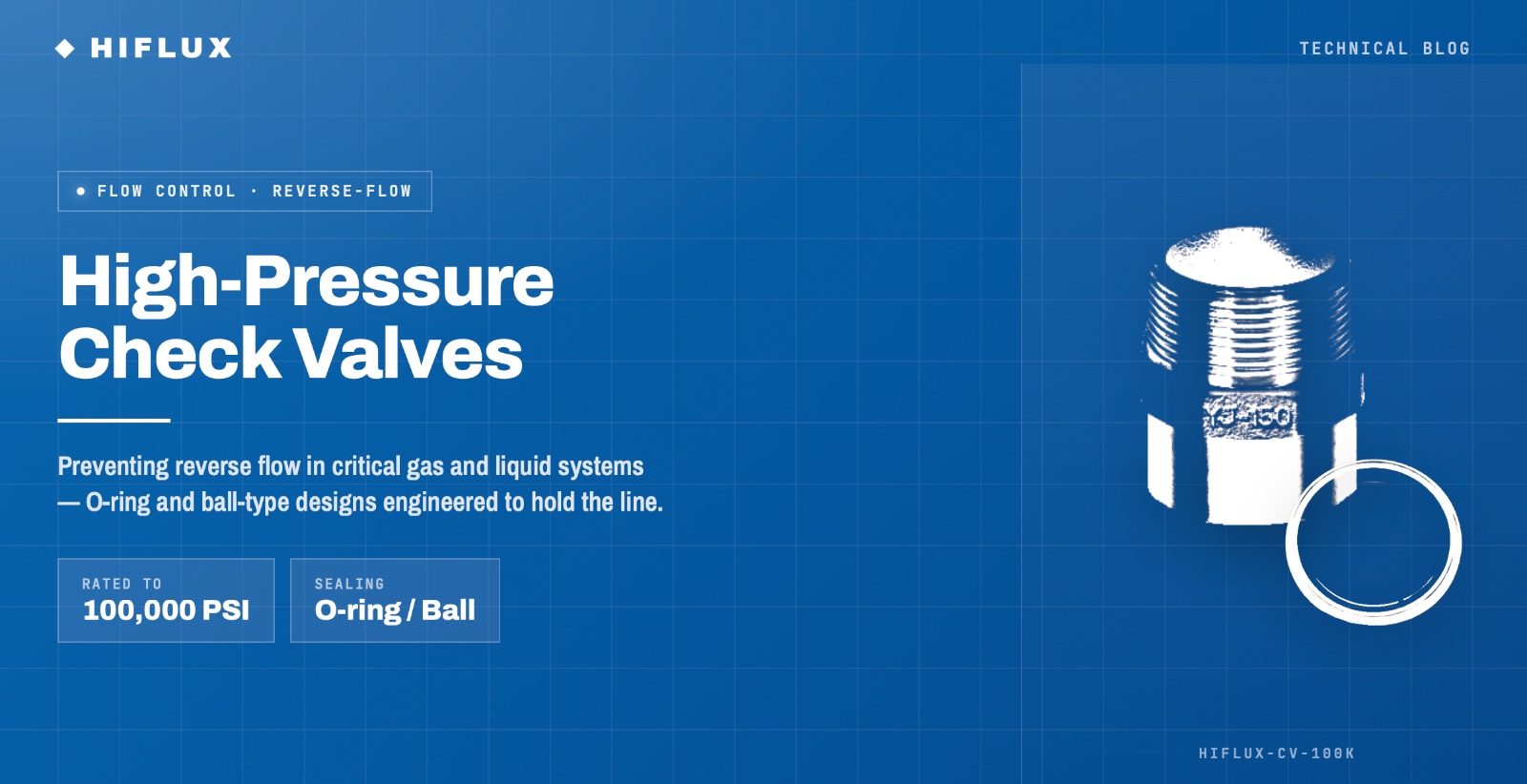
A check valve is a direction-sensitive valve that operates automatically. During normal forward flow, system pressure moves the internal sealing element away from its seat, allowing gas or liquid to pass through the valve. If the pressure direction changes, the sealing element returns towards the seat and blocks the reverse flow path.
According to the HIFLUX catalogue, the check-valve range is designed to block flow in one direction, allow flow in the intended direction, prevent the backflow of gas or liquid and support one-way media transfer. Correct installation orientation is therefore essential.
Reverse flow can develop because of pressure loss, pump shutdown, compressor cycling or pressure differences between connected sections of a system. Without a suitable non-return valve, reverse flow may lead to:
Unwanted pressure transfer from downstream sections into upstream pipework or equipment.
Process instability in systems designed around one-directional flow.
Equipment disruption affecting pumps, compressors, regulators or instruments.
Cross-contamination where different gases or liquids are used in connected system sections.
A correctly selected high-pressure check valve helps maintain the intended flow direction and supports the stability of the wider high-pressure system.
HIFLUX classifies its check valves according to pressure rating, tube size and sealing type:
10,000 psi — 1/2" — O-ring and ball type available.
15,000 psi — 1/8", 1/4", 3/8" — O-ring and ball type available.
20,000 psi — 1/4", 3/8", 9/16", 3/4", 1" — O-ring and ball type available.
30,000 psi — 1/8", 1" — O-ring and ball type available.
60,000 psi — 1/4", 3/8", 9/16" — O-ring and ball type available.
100,000 psi — 1/4", 3/8" — ball type only, no O-ring option.
The catalogue specifically states that the 100,000 psi check-valve range is not available in an O-ring configuration. These models are listed only as ball-type check valves.
The HIFLUX catalogue identifies two principal sealing arrangements. Both are intended to prevent reverse flow, but they use different internal sealing elements.
O-ring type: sealing element is an O-ring, maximum catalogue pressure 60,000 psi, O-ring is the replaceable component, not available at 100,000 psi. Main selection consideration is seal and media compatibility.
Ball type: sealing element is an internal ball, maximum catalogue pressure 100,000 psi, ball is the replaceable component, available at 100,000 psi. Main selection consideration is higher-pressure model availability.
The O-ring design uses an elastomeric sealing element to help restrict reverse flow. HIFLUX lists O-ring-type check valves at selected pressure ratings from 10,000 psi to 60,000 psi and identifies easy O-ring replacement as a product feature.
The specific O-ring material and operating-temperature range are not stated in the check-valve section of the catalogue. These points should therefore be confirmed before specifying a valve for a particular gas, chemical or temperature condition.
The ball-type design uses an internal ball as the sealing element. During forward flow, the ball moves away from its sealing position. If flow begins to reverse, the ball returns towards the seat and restricts the reverse path.
HIFLUX lists ball-type check valves at 10,000, 15,000, 20,000, 30,000, 60,000 and 100,000 psi. The ball-type configuration is the only sealing arrangement shown for the 100,000 psi models.
CV15OS02 — 15,000 psi — 1/8" tube — 1.4 mm orifice — O-ring.
CV15BS04 — 15,000 psi — 1/4" tube — 3.2 mm orifice — Ball.
CV20OS06 — 20,000 psi — 3/8" tube — 5.2 mm orifice — O-ring.
CV20BS12 — 20,000 psi — 3/4" tube — 11.1 mm orifice — Ball.
CV60OS04 — 60,000 psi — 1/4" tube — 2.4 mm orifice — O-ring.
CV60BS09 — 60,000 psi — 9/16" tube — 4.8 mm orifice — Ball.
CV100BS04 — 100,000 psi — 1/4" tube — 2.4 mm orifice — Ball.
CV100BS06 — 100,000 psi — 3/8" tube — 2.4 mm orifice — Ball.
The catalogue notes that all listed dimensions are for reference and may differ from the final manufactured product.
The 15,000 psi range includes O-ring and ball-type models in 1/8, 1/4 and 3/8-inch tube sizes:
CV15OS02 / CV15BS02 — 1/8" tube — port H1502 — 1.4 mm orifice.
CV15OS04 / CV15BS04 — 1/4" tube — port H1504 — 3.2 mm orifice.
CV15OS06 / CV15BS06 — 3/8" tube — port H1506 — 5 mm orifice.
The 20,000 psi range covers tube sizes from 1/4 inch to 1 inch:
CV20OS04 / CV20BS04 — 1/4" tube — port H2004 — 2.8 mm orifice.
CV20OS06 / CV20BS06 — 3/8" tube — port H2006 — 5.2 mm orifice.
CV20OS09 / CV20BS09 — 9/16" tube — port H2009 — 5 mm orifice.
CV20OS12 / CV20BS12 — 3/4" tube — port H2012 — 11.1 mm orifice.
CV20OS16 / CV20BS16 — 1" tube — port H2016 — 7 mm orifice.
The available orifice sizes differ across the range, so engineers should consider both the nominal tube size and the internal flow passage.
For higher-pressure service, HIFLUX lists O-ring and ball-type check valves in 1/4, 3/8 and 9/16-inch tube sizes:
CV60OS04 / CV60BS04 — 1/4" tube — port H6004 — 2.4 mm orifice.
CV60OS06 / CV60BS06 — 3/8" tube — port H6006 — 3.2 mm orifice.
CV60OS09 / CV60BS09 — 9/16" tube — port H6009 — 4.8 mm orifice.
The HIFLUX ultra-high-pressure check-valve range includes two 100,000 psi ball-type models:
CV100BS04 — port H10004 — 1/4" tube — 2.4 mm orifice — 103.1 mm overall length.
CV100BS06 — port H10006 — 3/8" tube — 2.4 mm orifice — 114.5 mm overall length.
HIFLUX states that its high-pressure check valves use cold-worked Stainless Steel 316, presented in the catalogue as providing the corrosion resistance required for high-pressure service.
Material suitability should still be assessed against the exact gas or liquid, chemical concentration, system temperature, external environment and pressure conditions. Stainless Steel 316 construction does not mean that the valve is automatically compatible with every process medium.
The HIFLUX range uses a cone-and-thread connection intended to help prevent gas and liquid leakage. In this type of connection, the prepared tube end forms the sealing interface while threaded components secure the connection.
Correct tube preparation and assembly are important because connection integrity depends on the complete installation, not only the valve body. The valve, tubing, fittings and adapters should all have compatible pressure ratings and connection dimensions.
One-way operation — helps prevent reverse flow of gas or liquid.
O-ring and ball sealing options — provides different sealing configurations.
Pressure ratings up to 100,000 psi — supports selected ultra-high-pressure systems.
Cold-worked Stainless Steel 316 construction — provides corrosion resistance for high-pressure service.
Cone-and-thread connection — intended to reduce gas or liquid leakage.
Replaceable O-ring and ball — supports maintenance and internal component replacement.
Multiple tube and port sizes — allows selection around the piping arrangement.
A valve should not be selected from pressure rating alone. Several factors need to be reviewed together:
Pressure rating — what is the maximum pressure the valve may experience?
Medium — will the valve handle gas, liquid or both?
Sealing type — is an O-ring or ball configuration required?
Tube size — does the valve match the connected tubing?
Port type — is the HIFLUX port designation compatible with the system?
Orifice size — can the internal passage support the required flow?
Material compatibility — is Stainless Steel 316 suitable for the process medium?
Flow direction — can the valve be installed according to its marked direction?
Maintenance access — can the valve be safely isolated and depressurised?
The pressure rating must be suitable for the system's operating conditions. The HIFLUX range covers several pressure classes, but not every tube size or sealing type is available at every pressure.
1/4 and 3/8-inch models at 100,000 psi.
1/4, 3/8 and 9/16-inch models at 60,000 psi.
A wider range from 1/4 to 1 inch at 20,000 psi.
HIFLUX states that the check valves can be used with both gas and liquid. The specific medium must still be reviewed against the body material, internal sealing components, pressure, temperature and required leakage performance.
The catalogue gives an orifice size for each check-valve model. A larger tube connection does not always mean the same internal orifice size.
The 20,000 psi 3/4-inch model has an 11.1 mm orifice.
The 20,000 psi 1-inch model has a 7 mm orifice.
Both 100,000 psi models have a 2.4 mm orifice.
The valve must be installed according to the flow arrow marked on the body. Installation planning should also consider accessibility, tube alignment, space for removal, isolation before maintenance and safe system depressurisation.
The HIFLUX catalogue identifies easy O-ring and ball replacement as a product feature. Replacement work should only take place after the system has been:
Isolated.
Fully depressurised.
Confirmed safe for maintenance.
Cleaned where required for the process medium.
The same HIFLUX catalogue section includes high-pressure line filters. Although the products may have a similar external format, they perform different functions.
High-pressure check valve — prevents reverse flow — O-ring or ball type.
High-pressure line filter — captures particles in the media — cup-type element.
A system using both — provides directional control and filtration — separate valve and filter components.
HIFLUX lists cup-type filter elements with filtration options ranging from approximately 2 to 90 micrometres. A filter is not a substitute for a check valve. Where a system requires both contamination control and reverse-flow prevention, both components may be needed.
Based on their stated function and pressure range, HIFLUX check valves may be considered for high-pressure gas and liquid systems requiring one-way flow, including:
High-pressure piping assemblies.
Pressure-testing equipment.
Gas-handling systems.
Hydraulic equipment.
Pump and intensifier systems.
Research equipment.
Chemical and process systems.
Oil and gas equipment.
Ultra-high-pressure installations.
Application suitability must be determined from the actual process conditions and the selected catalogue model.
A high-pressure check valve may be compact, but its role within the system is important. By restricting reverse flow, it helps maintain the intended movement of gas or liquid and reduces the possibility of unwanted pressure transfer between system sections.
The HIFLUX range includes O-ring and ball-type sealing arrangements, pressure ratings from 10,000 to 100,000 psi, tube sizes from 1/8 to 1 inch across selected ranges, cold-worked Stainless Steel 316 construction, cone-and-thread connections and replaceable O-ring and ball components.
For critical high-pressure systems, the correct non-return valve supports more than basic reverse-flow prevention. It contributes to controlled media movement and the reliable operation of the complete pressure system.
Get in touch with our team to discuss pressure ratings, sealing types and tube sizes for your application.

.png&w=96&q=75)