


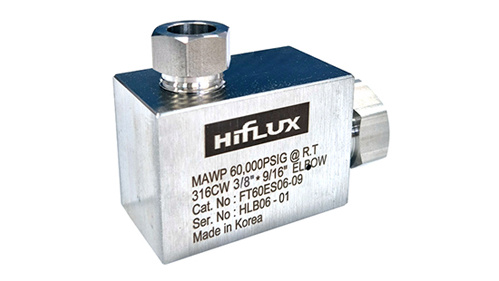
High pressure cone and thread fittings are the standard way to connect tube, valves and fittings in systems that run well beyond the limits of compression fittings. The tube end is machined to a cone and threaded; a gland pushes that cone into a matching conical seat in the fitting body, and the seal is made metal to metal, with no O-ring or soft packing in the joint.
The HIFLUX range covers ratings from 10,000 psi to 150,000 psi in cold-formed stainless steel 316, in elbow, tee and cross bodies with matched glands, collars and sleeves. The catalogue gives an operating temperature range of −423°F (−252°C) to 1200°F (649°C), and lists chemical, refining, research, oil and gas as the main industries served.
This guide is written for engineers specifying a system and for buyers putting together a bill of materials. It covers how the connection seals, how the parts fit together, how to choose between pressure classes, and where joints usually go wrong.
How a cone and thread connection seals
Above 20,000 psi, the HIFLUX connection uses a 60° cone. The fitting body has a conical seat machined into each port. The tube or nipple end is coned to a slightly sharper angle, and the HIFLUX coning tool is designed to cut at approximately 57 to 59°. Because the two angles differ slightly, the tube cone first touches the seat along a narrow ring, not across a broad face. When the gland is tightened, that narrow contact carries a very high bearing stress and the metal deforms slightly to form the seal.
The threads do a different job. A collar screws onto a left-hand thread cut on the outside of the tube. The gland slides over the tube behind the collar and screws right-hand into the fitting body. Tightening the gland pushes on the collar, which drives the cone into the seat and holds it there against line pressure. The threads hold the tube in place; the cone makes the seal.
There are two practical consequences. First, the condition of the cone and the seat matters more than anything else in the joint: a scratch, burr or flat on either surface becomes a leak path. Second, because there is no elastomer, the joint suits gas and liquid service at high pressure and temperature, and HIFLUX describes the connection as reusable and field-serviceable.
What makes up a fitting
A fitting on its own is only the body. Each connection also needs an accessory set, and the parts change with pressure class:
Fitting body: elbow, tee or cross. Part numbers follow the HIFLUX system, so FT60ES06 is a fitting, 60,000 psi, elbow type, 3/8".
Gland: the threaded nut that screws into the body port and loads the joint. Part numbers start FA with a G type code, for example FA60GS04.
Sleeve: used with the gland at 10,000 and 15,000 psi (type code S, for example FA15SS04).
Collar: used with the gland at 20,000 psi and above, screwed onto the left-hand tube thread (type code R, for example FA20RS06).
Collet: added in anti-vibration assemblies (type code T, for example FA20TS04-AV).
Tube or nipple: plain tube that you cone and thread yourself, or a nipple supplied coned and threaded to length.
The full set of glands, collars, sleeves, collets and plugs is listed under high pressure fitting accessories. Glands and sleeves or collars are supplied as matched sets, and components do not cross the 20,000 psi split.
Pressure classes and connection systems
The HIFLUX catalogue groups connections into four families. Each has its own port type designation (H1504, H2006, H6009 and so on), and the port type must match across every component in the joint.
Sleeve type, 10,000 and 15,000 psi: gland and sleeve with a 24° cone. Sizes are 1/8", 1/4" and 3/8" at 15,000 psi and 1/2" at 10,000 psi.
Medium pressure, 20,000 psi: gland, collar and nipple with a 60° cone, in 1/4", 3/8", 9/16", 3/4" and 1". This class is rated at 20,000 psi (1,370 bar) at room temperature.
High pressure, 30,000 and 60,000 psi: 1/8" and 1" at 30,000 psi (2,060 bar); 1/4", 3/8" and 9/16" at 60,000 psi (4,130 bar). Metric gland threads, M16×1.5P, M20×1.5P and M26×1.5P, are available at 60,000 psi alongside the UNF standard.
Ultra high pressure, 100,000 and 150,000 psi: 1/4", 3/8" and 9/16" at 100,000 psi, and 3/8" at 150,000 psi.
The whole range of high pressure fittings follows this structure, as do the valves, nipples, tube caps and manifold blocks that connect to them. That is what makes it practical to build a test rig or skid from one family of parts.
Comparing the options
Most specification decisions come down to three choices. Here is how they compare:
Sleeve type or collar type: the sleeve system (24° cone) covers 10,000 and 15,000 psi and does not need a threaded tube end. The collar system (60° cone) covers 20,000 to 150,000 psi and needs a left-hand thread on the tube for the collar. Choose by the maximum system pressure, not by what is already in stock.
Tube or nipple: tube is supplied plain and coned and threaded on site with a HIFLUX tooling set, which gives exact lengths and lets you rework a rig. Pre-coned and threaded nipples arrive ready to fit, ordered to the length you specify, with the end preparation done to the manufacturer's standard. Nipples have a minimum length per size; for a 1/4" 20,000 psi nipple the catalogue gives 70 mm.
Standard or anti-vibration: anti-vibration fitting and accessory sets add a collet to the assembly and carry an -AV suffix, for example FA60GS04-AV. They are available at 20,000 psi (1/4" to 1") and 60,000 psi (1/4" to 9/16").
For a first build, most buyers should start with nipples and add a tooling set once the layout settles.
Preparing coned and threaded tube
If you are cutting your own tube, end preparation sets the quality of every joint. HIFLUX tooling sets for 20,000 psi and 60,000 psi tube in 1/4", 3/8" and 9/16" include three tools:
Coning tool: cuts the cone at approximately 57 to 59°, with interchangeable cutters and collets (except 9/16" for 20,000 psi and 60,000 psi).
Threading tool: cuts the left-hand thread for the collar, for example 1/4"-28 LH, 3/8"-24 LH and 9/16"-18 LH. Dies and guide bushings are interchangeable, except for 1/8".
Reseating tool: repairs the conical seat of worn or damaged valves and fittings in place.
The tooling is listed under coning and threading tools. Tube is sold in 6 m lengths, and bends should respect the catalogue's minimum radii: for example 1.25" (31.8 mm) for 1/4" tube and 2.63" (66.8 mm) for 9/16" tube at both 20,000 psi and 60,000 psi. Bending tighter work-hardens the tube where the stress is highest. Where the route will not allow the radius, use an elbow fitting.
Common mistakes and failure points
Most leaks and failures on cone and thread systems trace back to a small number of causes:
Mixing pressure classes. A 20,000 psi gland will not suit a 60,000 psi port, and sleeves and collars are not interchangeable. Check that the port type matches on every part.
Damaged cones or seats. A dropped nipple or a cone dragged across a bench can be enough to cause a leak. Inspect both surfaces before assembly and use the reseating tool on worn ports.
Getting the thread hand wrong. Above 20,000 psi the collar and tube threads are left-hand while the gland threads into the body right-hand. Anyone assembling these for the first time should be told before they start.
Poor tube preparation. Off-angle cones, burrs left after threading, or threads cut too short to take the full collar all reduce the integrity of the joint.
Incorrect tightening. The catalogue gives a tube tightening torque chart by port type, for example 280 kgf·cm for a 1/4" 20,000 psi gland and 350 kgf·cm for a 1/4" 60,000 psi gland. Use the chart for the exact port type rather than tightening by feel.
Dry threads. Stainless threads can gall. HIFLUX Blue Lube thread lubricant is a PTFE-containing grease that lowers assembly torque and helps prevent seizure. The catalogue advises against using it where halogens, freon, nitrogen dioxide, strong acids or strong bases are present.
Ignoring vibration. Small-bore tube on a cycling or pulsating line fatigues at the thread root. Downstream of pumps and compressors, specify -AV fitting sets and clamp the run.
Manifold blocks and tube caps
Where several lines meet, a block is often neater than a cluster of tees and crosses. HIFLUX high pressure manifold blocks connect or distribute tubes of the same size and pressure, or of different sizes and pressures, into a single body. They are made from stainless steel 316, offered in 4-way, 5-way and 6-way types, and can be made to customer specifications with mixed port types.
For pressure testing a line or closing off a spare port, tube caps are available from 1/8" to 1" across the 10,000 to 60,000 psi classes. Like the fittings, both products use the same port types as the rest of the system.
Where cone and thread fittings are used
The same connection appears in a wide range of high pressure work:
Research and test laboratories, where rigs are rebuilt often and the reusable joint saves time. See our notes on research and testing applications.
Chemical processing and refining, where stainless steel 316 is needed for corrosion resistance at pressure.
Oil and gas, including wellhead and well-testing equipment.
Hydrogen systems, where all-metal sealing avoids depending on an elastomer in the joint.
In each case the fitting is only one part of the circuit. Valves, regulators and non-return devices need matching port types and ratings; our guide to high pressure check valves covers the check valves that sit on the same connection system.
Specifying with Hiflux UK
When you send an enquiry, include the maximum working pressure, the medium, tube size, the number and type of bodies, and whether you want plain tube or nipples cut to length. If vibration is likely, say so, and we will include anti-vibration sets in the quotation. We can also check port compatibility across the whole bill of materials before you order.
Frequently asked questions
It is a high pressure connection in which a coned and threaded tube end is held against a conical seat in the fitting body by a gland and collar (or sleeve at lower pressures). The seal is metal to metal, with no elastomer, and HIFLUX fittings of this type are rated from 10,000 psi to 150,000 psi.
In the HIFLUX range, the 24° gland-and-sleeve connection covers 10,000 and 15,000 psi. The 60° gland, collar and nipple connection covers 20,000 psi to 150,000 psi and needs a left-hand thread on the tube for the collar. Components from the two systems are not interchangeable.
Above 20,000 psi the collar screws onto a left-hand thread on the tube while the gland threads right-hand into the body. Assemblers should know this before they start, so they do not force a collar the wrong way.
No. Each class has its own port type, and glands, collars and sleeves are supplied as matched sets that do not cross the 20,000 psi split. Every part of a joint must share the same port type and rating.
Not necessarily. HIFLUX nipples are supplied already coned and threaded to the length you order. If you need to cut tube on site, HIFLUX coning and threading tooling sets are available for 1/4", 3/8" and 9/16" tube at 20,000 psi and 60,000 psi.
Use them on lines exposed to vibration or pressure pulsation, such as downstream of pumps and compressors. HIFLUX -AV sets add a collet to the assembly and are available at 20,000 psi (1/4" to 1") and 60,000 psi (1/4" to 9/16"). Clamp the tube run as well.
Yes. The joint can be broken and remade, provided the cone and seat are undamaged. Worn or damaged seats in valves and fittings can be repaired in place with a HIFLUX reseating tool.
Topics: Cone and Thread Fittings · High Pressure Fittings · Gland and Collar · Anti-Vibration Fittings · Stainless Steel 316 · HIFLUX