


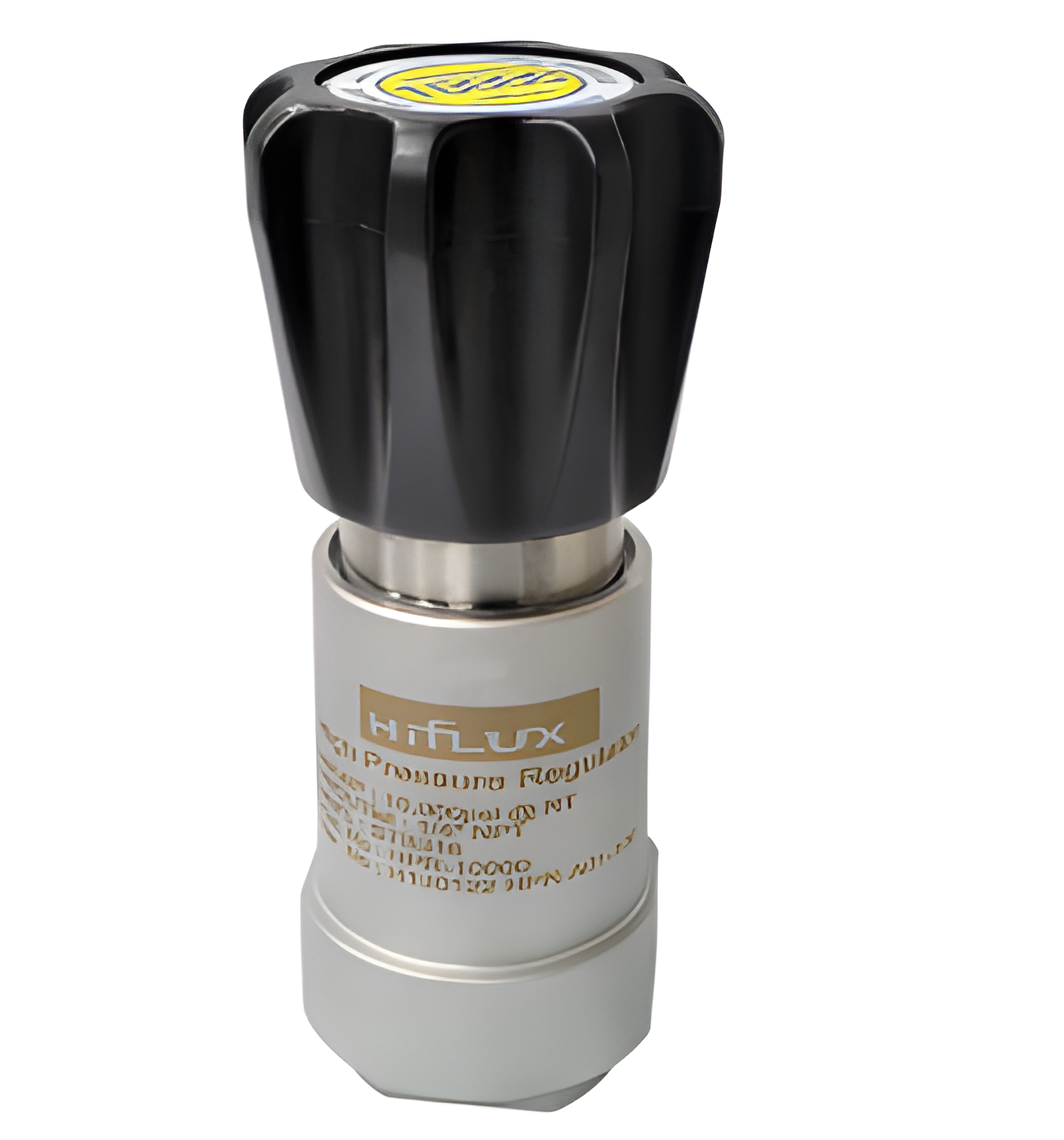
The Short Answer
The first question with any of the high pressure regulators in the HIFLUX range is which side of the regulator you need to control. If you need a steady, lower pressure delivered downstream from a higher-pressure source, you need a pressure-reducing regulator: the GPR for lower-pressure duty or the HPR for high-pressure duty. If you need to hold a vessel, reactor or line upstream at a set pressure and relieve anything above it, you need a back pressure regulator: the manually set BPR, or the ABPR where the set point must be adjusted by air signal or remotely.
The HIFLUX catalogue groups the range in exactly this way. The general pressure regulator (GPR) covers a maximum operating pressure of 3,500 psi, while the high pressure regulator (HPR) and the back pressure regulator (BPR) both reach 15,000 psi. The air operating back pressure regulator (ABPR) is listed in 10,000 psi and 20,000 psi versions. You can compare all four on the high pressure regulators page.
How a Pressure-Reducing Regulator Works
A pressure-reducing regulator balances a set spring force against the pressure acting on a sensing element. When outlet pressure falls below the set point, the spring wins, the main valve opens and more flow passes through. As outlet pressure rises back towards the set point, the sensing element pushes against the spring and the valve closes down. The regulator is therefore always responding to downstream pressure, not upstream pressure.
Three behaviours matter in practice:
Droop: as flow demand increases, the outlet pressure settles slightly below the no-flow set point because the spring has to extend to open the valve further.
Lock-up: at zero flow the regulator closes, and outlet pressure rises a little above the set point before the seat fully seals.
Creep: if the seat does not seal completely, outlet pressure slowly climbs at zero flow. On a high-pressure source this can take the downstream system well above its intended pressure, which is why seat condition and positive shut-off matter.
On the HPR, HIFLUX uses a spring-loaded piston sensor and an unbalanced stem that the catalogue describes as providing positive shut-off.
How a Back Pressure Regulator Works
A back pressure regulator is the reverse arrangement. HIFLUX describes the BPR as "the opposite concept" of a conventional regulator: instead of regulating the outlet, it maintains the pressure at its inlet at a constant, chosen level. The valve stays closed while upstream pressure is below the set point. Once upstream pressure exceeds the set point, the valve opens and passes the excess flow to the outlet, then reseats as pressure falls back.
This makes a BPR the natural choice for holding a reactor, separator or test vessel at pressure while fluid is continuously fed in, for keeping a pump or compressor loaded against a steady head, or for maintaining pressure in a sampling loop. It is a control device rather than a safety device. A back pressure regulator should not replace a certified relief valve; overpressure protection still needs its own dedicated device, such as a factory-set safety relief valve.
GPR vs HPR vs BPR vs ABPR at a Glance
The comparison below uses figures from the HIFLUX catalogue and product data only.
GPR (General Pressure Regulator): pressure-reducing, controls outlet pressure. Maximum operating pressure 3,500 psi, product series from 500 psi to 3,000 psi. Operating temperature -40°C to 100°C. SS316L VAR construction, standard 15 μin surface finish, no threads through the wetted path, Normal or Panel body types.
HPR (High Pressure Regulator): pressure-reducing, controls outlet pressure. Maximum operating pressure 15,000 psi, series of 2,000, 4,000, 6,000, 10,000 and 15,000 psi. Convertible to six outlet pressure ranges, captured venting available, NACE-compatible option. Operating temperature -55°C to 100°C. Catalogue models have 1/4" NPT inlet and outlet ports and a 2.1 mm orifice.
BPR (Back Pressure Regulator): controls inlet pressure. Maximum operating pressure 15,000 psi, series of 800, 2,000, 4,000, 6,000, 10,000 and 15,000 psi. Six relief pressure ranges, accuracy of 1% of the relief pressure range, bubble-tight shut-off at all reseat pressures, NACE-compatible option. Operating temperature -55°C to 100°C. Catalogue models have 1/4" NPT ports, with a 2.5 mm orifice on the 800 to 4,000 psi models and 1.7 mm from 6,000 psi upwards.
ABPR (Air Operating Back Pressure Regulator): controls inlet pressure, with the set point adjusted by air pressure through an electronic regulator and capable of remote control. Available in 10,000 psi and 20,000 psi versions, using 0 to 5 bar operating air on the 10,000 psi model and 0 to 3 bar on the 20,000 psi model. Six discharge pressure ranges, bubble-tight shut-off, optional high-flow Cv 0.6 model. Operating temperature -55°C to 100°C.
Both the HPR and BPR are listed in Normal and CO2 versions at each pressure rating.
GPR: General Pressure Regulator
The GPR is the lower-pressure member of the family, intended for duties up to a maximum operating pressure of 3,500 psi. HIFLUX highlights a compact body with a smooth, unobstructed flow path, SS316L VAR construction and no threads through the wetted path, which reduces places for contamination to collect. It is repairable and changeable on site rather than needing full replacement, and O-rings are offered in Urethane, NBR, Viton or Silicone to suit the media. The choice of Normal or Panel body suits both in-line installation and instrument or control panels.
HPR: High Pressure Regulator
The HPR is the pressure-reducing regulator for high-pressure service, with ratings up to 15,000 psi. It converts to six different outlet pressure ranges, so a single body can be set up for different downstream requirements by changing the range rather than the whole regulator. The main valve cartridge is designed for easy maintenance, captured venting is available, and a NACE-compatible option is offered for sour service. For high-pressure gas test stands, cylinder let-down and injection systems, the HPR is usually the starting point.
BPR and ABPR: Holding Upstream Pressure
The BPR is a manually set back pressure regulator rated to 15,000 psi, with six relief pressure ranges and a stated accuracy of 1% of the relief pressure range. Its bubble-tight shut-off at all reseat pressures is important where the process side must hold pressure without bleeding down between relief events.
The air operated back pressure regulator works on the same principle but replaces the manual set point with an air-pressure signal from an electronic regulator. That allows the back pressure to be changed from a control system or remote location, which suits automated test rigs, pressure-stepping programmes and installations where the regulator is not easy to reach. The ABPR extends the back pressure range to 20,000 psi. HIFLUX product data lists ABPR variants in Stainless Steel 316 for 1/4", 3/8" and 1/2" tube, plus a Hastelloy version for 1/4" tube.
Pressure Regulator Selection Factors
Once you know whether you are controlling the outlet or the inlet, work through the following before specifying a part:
Inlet pressure: the maximum pressure the regulator body will see, including upset conditions, must sit within the rating of the chosen series.
Control range: choose the outlet range (HPR) or relief range (BPR, ABPR) so that the normal set point sits comfortably within it, not at either extreme, where resolution and stability are usually poorer.
Media: gas or liquid, and whether CO2 is involved. The HPR and BPR are catalogued in both Normal and CO2 versions.
Seal and O-ring compatibility: Urethane, NBR, Viton and Silicone each suit different chemicals and temperatures. Confirm compatibility with your exact medium.
Temperature: the GPR is rated from -40°C to 100°C and the HPR, BPR and ABPR from -55°C to 100°C, for both ambient and fluid temperature. Account for cooling during gas expansion across the regulator.
Flow: the orifice size and, on the ABPR, the high-flow Cv 0.6 option limit how much flow the regulator can pass. A regulator sized too small for the flow will droop badly; one far oversized may hunt at low flow.
Sour service: specify the NACE-compatible option where hydrogen sulphide is present.
Control method: manual set point (BPR) or air signal with remote adjustment (ABPR).
Connections: catalogue HPR and BPR models use 1/4" NPT ports, so plan the transition to cone-and-thread high pressure fittings and high pressure tubing with suitable union adapters.
Common Mistakes When Specifying High Pressure Regulators
Using a pressure-reducing regulator where a back pressure regulator is needed. If the requirement is to hold a vessel at pressure, a reducing regulator downstream of it will not do the job.
Treating a BPR as a safety relief valve. A back pressure regulator controls process pressure; overpressure protection needs a dedicated relief device.
Selecting by pressure rating alone. Range, flow, seal material and temperature all affect whether the regulator will hold its set point.
Ignoring creep on pressure-reducing service. Without a sound seat and positive shut-off, a high-pressure source can slowly pressurise the downstream system. Downstream relief protection should always be considered.
Overlooking reverse flow. Where downstream pressure can exceed upstream, a high-pressure check valve may be needed to protect the regulator and the source.
Forgetting maintenance access. The HPR's main valve cartridge and the GPR's on-site repairability only help if the regulator can be isolated and depressurised safely.
Where Each Regulator Is Used
HIFLUX lists its regulators for high-pressure fluid handling in chemical, petrochemical, water-jet, research and oil and gas industries. Typical matches include:
Research and testing: HPRs set test pressure from high-pressure gas supplies, while BPRs and ABPRs hold rig or vessel pressure, with the ABPR suited to automated or remotely stepped tests.
Chemical processing: BPRs maintain reactor and separator pressure during continuous feed, and pressure-reducing regulators set and hold line pressure.
Wellhead pressure control: the NACE-compatible options on the HPR and BPR are relevant where sour media is present.
Panel and instrumentation duty: the GPR's Panel body type suits lower-pressure gas distribution and analyser supply.
For any application, confirm material and seal compatibility with your exact medium before ordering.
Getting the Specification Right
The quickest way to a correct quote is to send us the medium, maximum inlet pressure, required set point or relief range, expected flow, temperature range and connection preference. With that information we can confirm whether a GPR, HPR, BPR or ABPR fits, and which range, seal and port options to specify, alongside matching high pressure valves, fittings and tubing from the same HIFLUX system. Contact our team for selection support.
Frequently asked questions
A pressure-reducing regulator controls the pressure at its outlet, delivering a steady lower pressure downstream. A back pressure regulator controls the pressure at its inlet, staying closed until upstream pressure exceeds the set point and then relieving the excess. HIFLUX describes its BPR as the opposite concept of a conventional regulator.
According to the HIFLUX catalogue, the GPR has a maximum operating pressure of 3,500 psi, the HPR and BPR reach 15,000 psi, and the air operating back pressure regulator (ABPR) is available in 10,000 psi and 20,000 psi versions.
An air operated back pressure regulator holds upstream pressure in the same way as a standard BPR, but its set point is adjusted by an air-pressure signal rather than a manual spring adjustment. On the HIFLUX ABPR, the setting is controlled through an electronic regulator, using 0 to 5 bar operating air on the 10,000 psi model and 0 to 3 bar on the 20,000 psi model, and it can be controlled remotely.
A back pressure regulator is a process control device and should not replace a dedicated safety relief valve or rupture disc. Use a BPR to hold operating pressure and a separate certified relief device for overpressure protection.
Droop is the drop in outlet pressure below the no-flow set point as flow through a pressure-reducing regulator increases. It happens because the spring must extend to open the valve further. Choosing a regulator correctly sized for the flow and with a suitable control range keeps droop within acceptable limits.
The HPR and BPR are offered with a NACE-compatible option for sour service. Confirm the full material and seal specification against your process conditions when ordering.
Topics: Pressure Regulators · Back Pressure Regulator · High Pressure · Pressure Control · HIFLUX